
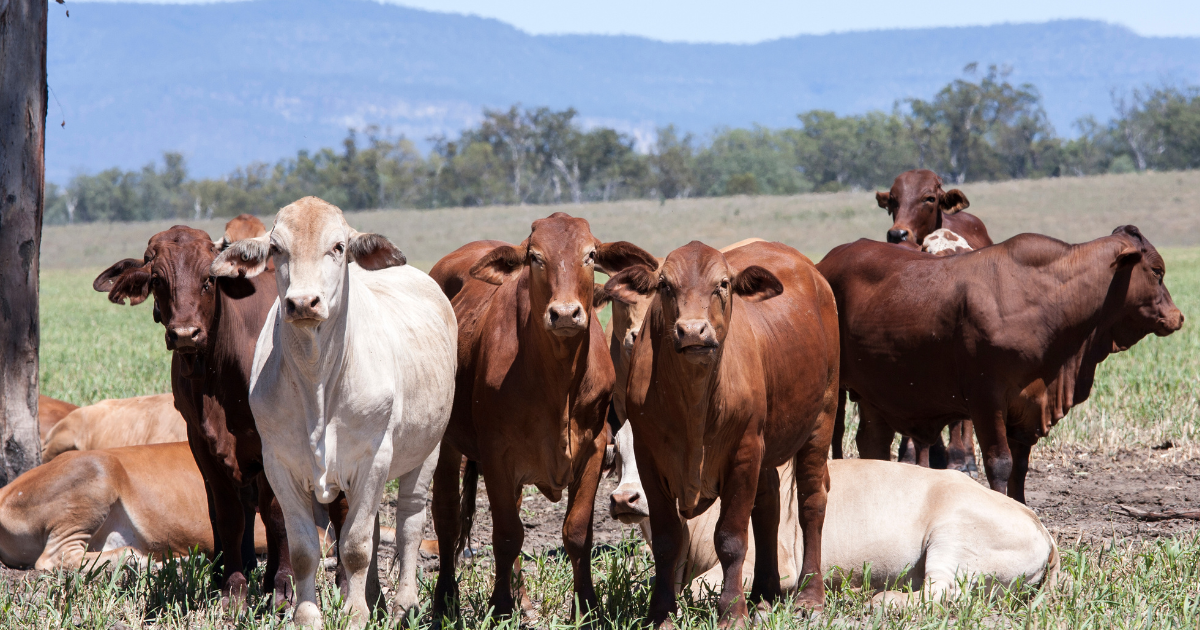

Greg and Sonya Spencer run an organic cattle operation across two blocks 100km apart in Central Queensland's Central Highlands, west of Emerald. Between them, the properties total 10,000 hectares: a 5,000-hectare breeding block and a 5,000-hectare fattening and trading block. Their herd is a composite mix built around Brahman genetics, with Charolais, Droughtmaster, Angus, and Brangus thrown in for good market flexibility.
In good seasons, the aim is simple: take cattle through to slaughter as organic steers or heifers. Greg has been running AgriWebb since 2017. Farmbot came not long after. For Greg, the value shows up less in the software and more in the decisions it leads to.
"We are grass farmers, not beef farmers"
Greg runs a cell grazing, time-controlled operation, moving mobs as large as 1,600 head between paddocks, sometimes daily. Every move used to mean guessing how much grass was actually left behind. Now, when cattle come out of a paddock, AgriWebb's grazing plan gives him a good indication how much they consumed.
"You can go, 'Oh okay, well there was a bit more grass in that paddock than I thought,' or 'Might have to re-budget because they've taken out more than I thought,'" Greg says. "That's all sort of immediate feedback straight away…so you can adjust on the fly."
It's a small shift with a big effect: instead of finding out he's short on feed when it's already a problem, Greg finds out the day it happens.
{{quote1}}
Reading the season early
Earlier this year, the forecast for Central Queensland wasn't looking good, so Greg and his team sat down, ran a feed budget using consumption data pulled straight from AgriWebb, and made a call: sell early.
"We did a budget on what feed we had, and using the data from feed consumption over time through AgriWebb, we were able to make some decisions and went early," Greg says. "If we were trying to sell cattle now, we'd be behind the eight ball. Prices dropped, the feed's gone."
It's not a decision Greg takes lightly. Shifting large numbers of cattle ahead of the market is a hard call to make on instinct alone. But when the data says the grass will run out by a certain month, the decision becomes less of a gamble and more of a plan.
"When you don't have the grass in front of you and the data's telling you, 'Well hang on, if you hold onto these, you're going to run out of grass by September,' it makes you more comfortable with the decision," Greg says. "Instead of going, 'Oh yeah, we'll be right.'"
Grazing plans the whole team can act on
Four people are involved in building Malthoid Organic Beef feed budgets, and once the numbers are in AgriWebb, everyone can see them, not just Greg and Sonya. That matters on a property where there are various teammates in charge of moving cattle on any given day
"They've got the plan in front of them," Greg says. "When they do a move, they can say, 'That paddock doesn't look as good as what we thought,' so you might have to re-budget because they've taken out more than I thought.
Since moving to Individual Animal Management, Greg has also stopped estimating his Livestock Standard Units and started calculating them directly from actual animal weights, another layer of precision that feeds straight back into the grazing plan.
Planning water around the way cattle actually graze
Feed budgeting doesn't happen in isolation. Greg also uses AgriWebb's mapping tools to plan trough placement, aiming to keep water within 500 metres to a kilometre of grazing cattle. For mobs of up to 1,600 head needing 2 litres a second at a trough, that planning has real consequences.
Combined with real-time monitoring from Farmbot, that planning becomes proactive rather than reactive. Greg gets alerted to a rapid drop in tank level before it becomes a crisis, and he can see grazing and water data side by side to understand how his herd is actually moving through the landscape, including watering patterns he wouldn't have known about otherwise. Cattle he expected to drink at midday sometimes come in at 4am instead, information that has changed how and when he musters.
Less guessing, more grazing
For Greg, the value isn't in any single feature. It's in not having to duplicate work across separate tools anymore. Before AgriWebb's grazing planner, he used a separate planning platform alongside spreadsheets and paper. Now the budget, the grazing chart, the LSU calculations, and the paddock history all live in one place.
"It's a very, very powerful tool," Greg says. "Because everything's on the one platform now, before you had another grazing planner. Now that it's [AgriWebb] everything, it's just streamlined everything."
The result is a farm where decisions get made earlier, with more confidence, and with the whole team working from the same numbers, whether that's deciding to sell cattle in April instead of September, or simply knowing which paddock still has grass left in it today.
Turn today's grazing data into next season's plan. Try AgriWebb for free today and see how digital grazing plans can transform your operation from the office to the paddock.