The "Single Record" strategy: How to make sustainability a byproduct of profitability
Over the last few years, the beef sustainability conversation has reached a tipping point: we’ve moved past debating feasibility and into the work of execution. The question is no longer "Should we?" but "How do we actually make this happen at scale?". At AgriWebb, we are answering that question in real time through deep-tier partnerships with leaders like Nestlé Purina PetCare, McDonald's, Ahold Delhaize USA, and Cargill.
Our Chief Product Officer Phil Chan previously outlined the specific farm and ranch-level data points required to power these programs. But the truth is, while the industry has the buy-in, the science, and the capital, very few projects ever make it past a pilot. Knowing what data points we need is one thing, architecting systems that can collect farm data in low-friction, high-quality ways, is another.
I’ve spent the last decade building digital solutions across the food chain, from launching the first registry-approved soil carbon program at Indigo Ag to leading digital solutions for specialty crops at Wilbur-Ellis. From row crops to orchards to cattle operations, the story is the same: sustainability programs struggle to scale because they are built on foundations of unstructured, inaccessible data. To move from pilots to planet-scale impact, we don’t need more data – we need better data architecture.
The hurdle: An extractive data mess
Historically, data used to fuel beef sustainability programs has lived in notebooks, memories, or what I call a “graveyard of spreadsheets”. Data is trapped in disparate sources, created for one-off pilots. This creates an extractive data model where the producer provides data but receives no immediate value in return. More importantly, this data is unstructured. It often lacks the spatial (where) and temporal (when) consistency required for auditability. Research from Trust in Food (2022) shows that this "data tax" is why only 3% of producers participate in carbon markets. When data is unstructured, it results in:- An accuracy cap. "Static data" collected once a year is stale. It’s hard to prove year-on-year Scope 3 improvements with a retrospective survey.
- An "80/20" dilemma. MRV providers spend 80% of their time cleaning noisy data rather than driving scale.
- Data fatigue. Every new program requires a new spreadsheet or data platform, leading to massive producer burnout.
Structure is the bedrock of scale
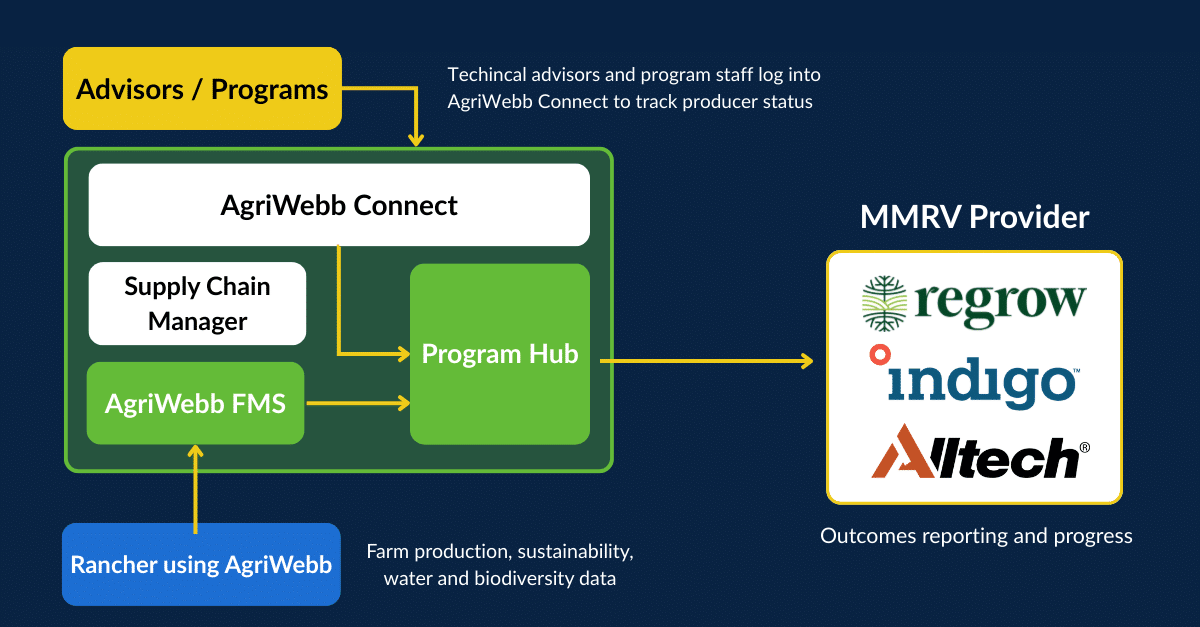
For a program to scale, data must be structured so it can be reused, shared, and analyzed across time and stakeholders. AgriWebb’s strategy is to structure data once, make it useful to producers everyday, and enable it to flow seamlessly to trusted partners. When data is structured smartly, a single record of a cattle movement can simultaneously support a producer’s grazing plan, a project sponsor’s data collection, and a brand’s emission claim. Our data model is structured on two principles:- Make data capture natural to farm and ranch operations. We don’t ask producers to be data scientists. We provide the tools they need to manage livestock and grazing profitably, both inside and outside of a program. When the source of truth is live, day-to-day records, proving Scope 3 improvements becomes a byproduct of good management rather than an extra chore.
- Provide value immediately and often. By structuring data as a living record—knowing what happened, where, and when—we create a feedback loop. We surface productivity insights in real time to the producer and, with their permission, to their trusted network. What does this look like in practice? It looks like a technical advisor reviewing live grazing data to suggest a mid-season intervention. The rancher sees higher weaning weights; the brand sees a reduced carbon intensity. Proper data structure turns a 'report on the past' into a 'driver for the future.'
The next evolution: AgriWebb Program Hub
To bridge the gap between the ranch and the boardroom, we launched Program Hub. It builds on our structured data foundation to solve the multi-stakeholder challenge of Scope 3 insetting. Program Hub provides real-time visibility into progress without rebuilding data workflows for every new program. It ensures:- Alignment & frictionless flow: Automatically aligns producer data to program requirements and moves it to MRVs seamlessly. No more spreadsheets.
- Security & interoperability: Producers own their data and choose who sees it. Permissioned data can be shared with various partners at the click of a button.
- Advisor empowerment: Technical advisors spend less time cleaning data and more time using a producer’s unique data to drive operational outcomes.
The key takeaway
AgriWebb is not just a digital notebook, it’s the data infrastructure for the future of the beef industry. By structuring ranch data to serve the producer first, we solve the operational bottleneck that has kept sustainability programs in the "pilot trap." This is how we move beyond buzzwords to create productive, resilient ranches and supply chains at a global scale.Key points