Is your stocking rate right for the season ahead?
(Written by Jessikah Cresswell, Marketing Executive)
A healthy stocking rate is the number of livestock your land can carry for a given period without drawing down the pasture faster than it can regrow. There’s no single number that applies to every property, it depends on your forage supply, rainfall, soil, and the class of stock you run. The right stocking rate matches your animals’ feed demand to what your land is actually producing, season by season.
Stocking rate vs. carrying capacity
- Stocking rate is what you’re actually running: the number of animals, usually expressed in Dry Sheep Equivalents (DSE), grazing your property over a season or a year.
- Carrying capacity is what your land can support: the maximum stocking rate it can sustain long term without pasture, soil, or animal performance declining.
A healthy operation keeps stocking rate at or below carrying capacity, with some buffer for dry seasons.
How to work out your stocking rate
- Convert your herd to DSE. A dry cow sits around 8–10 DSE, and a lactating cow with a calf at foot can run 20–25 DSE. Some operations use Livestock Units (LSU) instead, same principle. This lets you add a mixed herd into one feed demand figure.
- Estimate your forage. Usually based on standing pasture dry matter per hectare, adjusted for a realistic utilisation rate (commonly 25–60%, since pasture shouldn’t be grazed to bare ground).
- Divide forage by demand:
Stocking rate = total DSE ÷ total grazing hectares
This is a starting figure, not a fixed rule, check it against what you’re seeing on the ground.
Signs your stocking rate is off
Overstocked: bare or thinning ground, pasture grazed faster than it recovers, declining animal condition, weedier pasture composition.
Understocked: patch grazing, where stock keep returning to the same regrowth while the rest of the paddock matures past its feed value and goes to waste. Understocking wastes pasture just as surely as overstocking damages it.
Tracking and forecasting against your benchmark
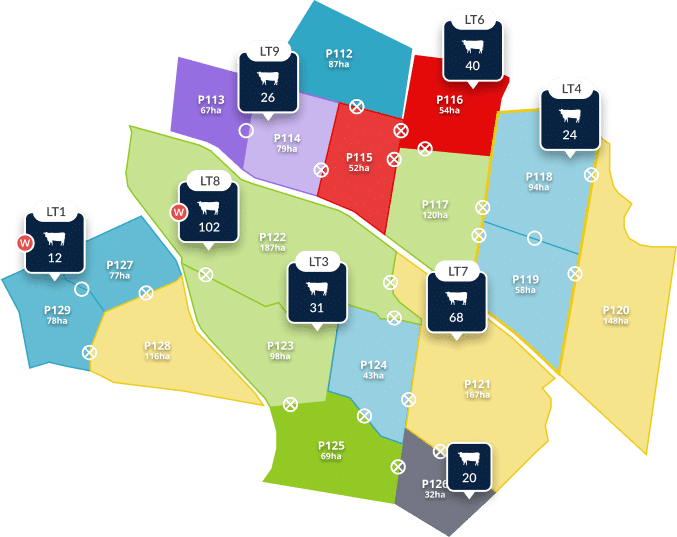
A single stocking rate calculation is a snapshot. What matters more is tracking it over time against your own benchmark, your long-term sustainable carrying capacity, adjusted for rolling rainfall so a dry year and a wet year are compared fairly. AgriWebb’s Stocking Rate vs Carrying Capacity report does this from your existing livestock and paddock records, showing the gap between the two, your capacity gap, so you can see exactly when in the season you tend to run hot or light.
It’s also worth looking forward, not just back. With the Grazing Planner add-on, you can project your planned stock flow (purchases, sales, weaning) against long-term rainfall averages to see an overstocking or understocking period coming months before it arrives, giving you time to line up a buyer, agistment, or supplementary feed rather than reacting after the fact.
Adjusting as conditions change
- Compare against your own paddock history, not a guess.
- Reassess before each season, and again the moment conditions shift.
- Keep the flexible numbers flexible: weaners, dry stock, and agistment are easier to move than your core breeding herd.
Ready to see it in action?
Discover how the Stocking Rate to Carrying Capacity tool can help you review historical performance, benchmark your operation and confidently plan future stocking decisions. Start your grazing planner trial today.
Frequently asked questions
What is a stocking rate? The number of livestock, in DSE, grazing a given area over a set period, usually a season or a year.
How do you calculate stocking rate? Total DSE ÷ total grazing hectares. DSE is based on estimated forage available divided by daily forage demand per DSE.
What’s the difference between stocking rate and carrying capacity? Stocking rate is what you’re running. Carrying capacity is the maximum your land can sustainably support. A healthy operation keeps the former at or below the latter.
Can you tell if you’re heading toward overstocking before it happens? Yes, with AgriWebb you can compare planned stock numbers against long-term rainfall and your benchmark carrying capacity, forecasting over or understocking months ahead and adjusting buying, selling, or agistment plans accordingly. Read more in the help article.